Cultural Psychology

Cultural Psychology

umber of Volumes 9
Number of Issues 18
Number of Articles 228
Number of Contributors 497
Article View 264103
PDF Download 148,533
View Per Article 1158.35
PDF Download Per Article 651.46
Number of Submissions 960
Rejected Submissions 709
Reject Rate 74
Accepted Submissions 205
Acceptance Rate 21

Journal of Cultural Psychology, affiliated to the Behavioral Sciences Department of the Institute for Research and Development in the Humanities of the Organization for the Researching and Composing University Textbooks in the Humanities (SAMT), obtained its Publication Permission according to the letter (Ref. No.: 55996/3/3 dated 09/06/2017) issued by the Director General of Research Policy and Planning  and  gained Scientific Degree (Rank B) from the Ministry of Science, Research and Technology in 2019.

The license for online publication (Reg. No.: 80411) of the journal of Cultural Psychology was issued by the Ministry of Culture and Islamic Guidance on 19/11/2017.

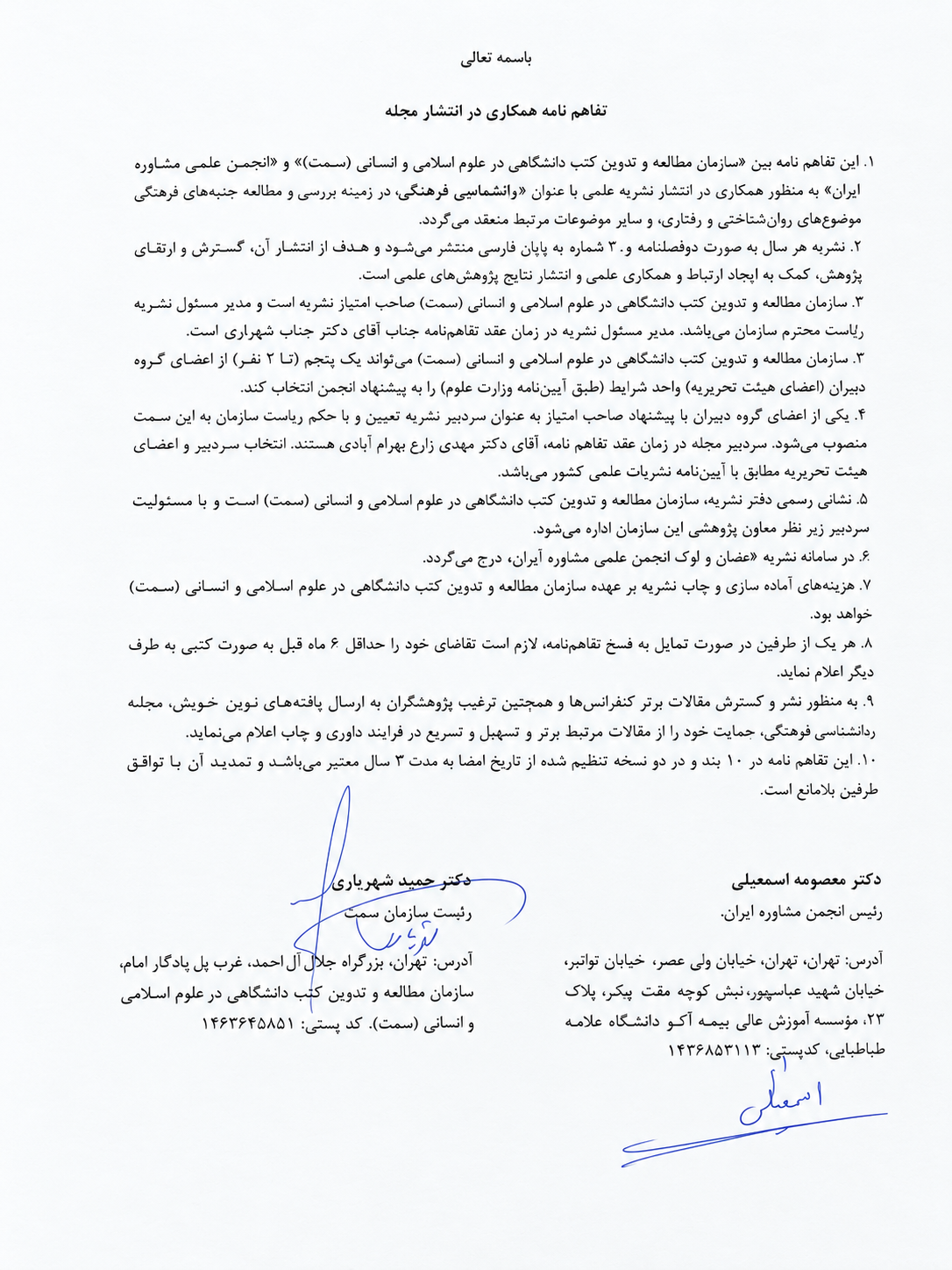
This journal has entered into a memorandum of understanding for scientific cooperation with the Iranian Scientific Association of Counseling.


Publication Frequency:  Biannual

 Review Policy: Double blind review

 Access: Open Access; Free of charge

Publication/Processing Fee: None


Journal Topics:

- Cognition and culture

- Identity and culture

- Personality and culture

- Emotional demonstrations in the cultural context

- Religious characteristics and the role of religion in Iranian culture

- Mental health and culture

- Psychotherapy and counseling in the cultural context

- Individual differences in the cultural context

- Language and culture

- Human development in the cultural context

- Social interactions

- Vocational behavior and culture

- Criticism of theories, models, and books on psychology from the perspective of cultural psychology

Keywords Cloud

  • culture
  • Islamic psychology
  • mental health
  • marital satisfaction
  • Grounded theory
  • Students
  • cultural intelligence
  • Family
  • Resilience
  • Psychometrics
  • adolescents
  • Stress
  • Reliability
  • post-traumatic growth
  • COVID-19
  • Conceptual model
  • Psychological Well-Being
  • Islamic Culture
  • psychological capital
  • Islamic sources
  • religion
  • Validation
  • Validity
  • Factor analysis
  • Questionnaire
  • self-efficacy
  • Iran
  • Theme analysis
  • Spirituality
  • Cultural Adaptation
  • Confirmatory Factor Analysis
  • Internet addiction
  • Religious Coping
  • Education
  • Emotional intelligence
  • Quran
  • Moral Intelligence
  • lived experience
  • emotion regulation
  • life satisfaction
  • Academic burnout
  • aggression
  • personality
  • high risk behaviors
  • Student
  • Marriage
  • Divorce
  • Modeling
  • critical thinking
  • academic procrastination
  • Social Support
  • Phenomenology
  • Adolescent
  • Qualitative method
  • early maladaptive schemas
  • self-compassion
  • adolescence
  • Academic motivation
  • Identity Styles
  • satisfied couples
  • earthly love
  • Attribution
  • interpersonal relationships
  • love
  • depression
  • Academic Buoyancy
  • Health
  • hope
  • Iranian
  • Self-esteem
  • attachment style
  • Iranian families
  • socio-cultural contexts
  • phenomenological study
  • Systematic review
  • autism
  • Emerging Adulthood
  • Self-differentiation
  • adaptation
  • Thematic Analysis
  • Prevention
  • children
  • Gender
  • life skills
  • enrichment of relationships
  • acceptance and commitment
  • anxiety
  • organizational support
  • depression disorder
  • Umbrella Review
  • Happiness
  • Scale
  • Lived experiences
  • \"Mental health\"
  • Curriculum
  • Psychological flexibility
  • Immigration
  • Psychological distress
  • Academic Identity
  • Positive psychology
  • attachment to god
  • Behavioral problems
  • Qualitative Content Analysis
  • Feasibility study
  • Monolingual
  • Cultural capital
  • ethical views
  • Careers without Borders
  • indrgenous treatment
  • Documentary Method
  • spiritual development
  • axiology.Relativism
  • Interactive teaching model
  • marital status
  • conflict resolution styles
  • Covid anxiety19
  • the Big Five/Five Factor model of personality
  • Parent-Child Relationship
  • Allameh Tabatabai
  • \"procrastination\"
  • conceptualization
  • Religious Adherence
  • \"high schools teacher\"
  • stress inculation
  • healthy person
  • cyberbullying
  • symbolic capital
  • adaptability requirements
  • retirement adjustment
  • style of attribution
  • Exist
  • Digital Mental Health
  • thinking
  • Positive affect
  • treatment failure
  • divine love
  • Support
  • Iranian adolescents
  • Schema modes
  • Islamic mysticism
  • زوج‌درمانی رفتاری- یکپارچه‌نگر
  • Ethnic Language
  • arrogance
  • Self- report
  • optimism
  • Collective Unconscious
  • mental health professionals
  • Unemployed Girls
  • family efficacy
  • Social Status
  • archetype
  • \"Marital Virtues\"
  • brain
  • Mutual Feelings
  • Pathological use
  • path analysis
  • religious reconstructing
  • Parenting stress
  • Perception
  • inner comfort
  • defense mechanism
  • dolls
  • Conceptual Models
  • Keywords: Institutionalizing the family\'
  • Suicidal thoughts
  • Self-Disability
  • Islam and Psychology
  • Flourishing
  • Elderly
  • System
  • repetition
  • personality psychology
  • Elders
  • Psychological transformation
  • types of gheirat
  • Social Fear
  • Mentalization
  • levels of emotional schemas
  • Educational Motivation
  • self-concept
  • Burn Disease
  • Grounded
  • Historical context
  • literary tradition
  • modest
  • Islam
  • Three Drops of Blood
  • benevolence
  • intimacy
  • and post-traumatic growth
  • Social Media addiction
  • Social Interpreter
  • Qualitative analysis
  • Ego strength
  • Hilm
  • Teachers
  • twelve-step treatment  
  • national identities
  • Information needs
  • non-adjustment